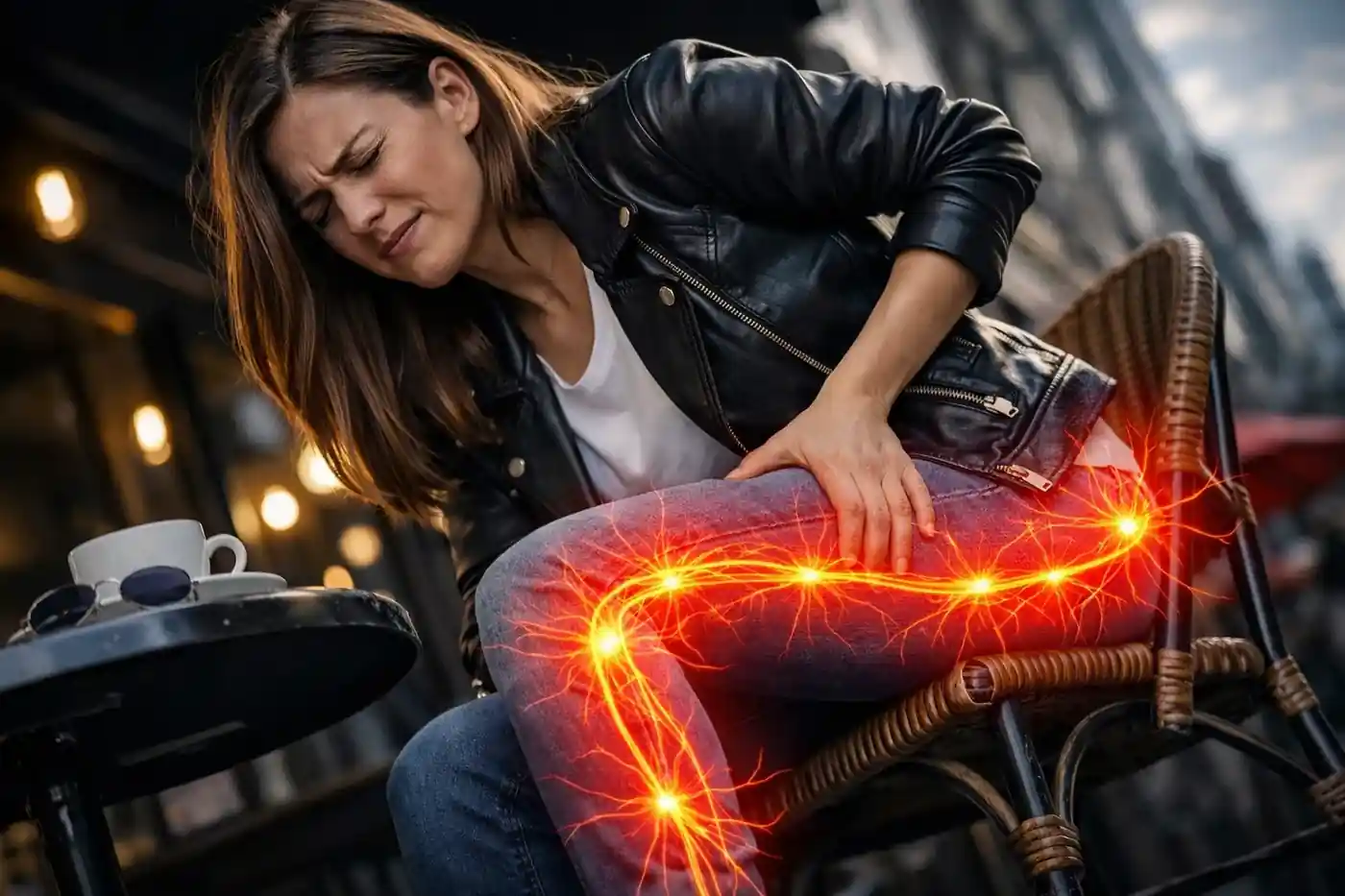
That knee creaking when you climb stairs. That stiffness in your fingers in the morning, which takes time to dissipate. That hip pain that persistently returns in damp weather.
You've been told it's osteoarthritis - the normal wear and tear of joints, the price of aging.
So you learn to live with it!
But in Chinese medicine, persistent pain is never inevitable. It's information. And this information deserves to be read...
An obstruction, not wear and tear... The "Bi" syndrome
When a patient sits across from me and describes their joint pain, my first thought isn't about crumbling cartilage. I think about obstructed circulation. In TCM, most chronic joint pains fall into the category of Bi Syndromes ("Bi Zheng" or painful obstruction syndromes). The word "Bi" means obstruction. It describes a situation where Qi (the vital energy that animates and warms the body) and Xue (Blood in the energetic sense, much broader than its biological definition) no longer circulate freely in the meridians that pass through your joints. It's not so much the wear and tear of the cartilage that causes pain, but the stagnation it maintains - or reveals.
What causes these obstructions? Most often, external pathogenic factors; what TCM calls "climatic perversities," which take advantage of an internal weakness to settle into the joints. Three of them systematically reappear.
Cold is the most frequent intruder. It contracts, freezes, slows down everything it touches. The pain it causes is acute, fixed, like an unyielding cramp. It worsens in cold weather, after immobility, and (a characteristic sign) it is relieved by heat. If a hot water bottle on your knee brings you real relief, Cold is most likely involved.
Dampness presents a very different picture. The pain is dull, heavy, difficult to pinpoint. The joints seem swollen, congested, and this sensation invariably worsens in humid or rainy weather. Patients often describe this feeling of being "rusty" in the morning, needing long minutes for the joints to function normally again.
Wind, for its part, is recognized by its mobility. Pain that moves (shoulder one day, knee the next, wrist the following week) often bears the signature of Wind. It is the least frequent of the three in chronic conditions, but it often opens the door to the other two.
In practice, these factors rarely combine alone. The most frequent picture for osteoarthritis is a Cold-Damp Bi: morning stiffness, fixed pain aggravated by cold and dampness, a sensation of heaviness in the affected limb. This energetic logic applies regardless of the affected joint: knee osteoarthritis (gonarthrosis), hip osteoarthritis (coxarthrosis), fingers, cervical or lumbar spine. The diagnosis remains individualized, but the starting principle is the same: lift the obstruction, and strengthen the terrain that allowed it to settle.
The source of the imbalance
Identifying the type of obstruction is one thing. Understanding why it was able to settle in is another. And that's where TCM becomes truly interesting! These pathogenic factors only penetrate durably if the internal terrain allows them to. A body whose energy is strong and circulating well naturally repels them. In Chinese medicine, the chronicity of osteoarthritis almost always reflects a deeper fragility.
The Kidney governs the bones. In TCM, the Kidney is the source of our fundamental vitality. It stores Jing (the inherited and acquired vital essence, our deep energy capital) and directly governs the bones and joints. With age, chronic overwork, or repeated illnesses, Kidney Jing depletes. Bones are less well nourished, joints become drier, more fragile. This is the underlying condition on which almost all TCM osteoarthritis develops - it's no coincidence that joint pain increases with age, a time when Kidney energy naturally declines.
The Spleen transforms what you eat into energy. If the Spleen is weakened (by a diet that is too cold, too sweet, or by intellectual overwork and rumination) it no longer correctly performs its transformation function. Fluids stagnate instead of being metabolized, and this internal Dampness will naturally lodge in the body's most fragile areas: the joints. Do you suffer from bloating, fatigue after meals, heaviness in your limbs? There's a strong chance your Spleen is involved in your joint pain.
Cartilage does not regenerate... and I won't tell you otherwise!! But pain and stiffness can, however, improve. Our job isn't to rebuild the joint; it's to remove what's oppressing it and strengthen what's abandoning it. That's an important nuance!
The Liver also plays a role, often underestimated. It ensures the free circulation of Qi throughout the body and nourishes tendons and ligaments. When it is under pressure - prolonged stress, accumulated frustrations, repressed anger - it becomes blocked. This stagnation aggravates pain and explains those joint flare-ups that strangely coincide with periods of tension. If you observe this phenomenon in yourself, note it: it's valuable information for refining the diagnosis.
My work in the clinic
In this energetic approach, the strategy is always twofold: to treat both the branch (relieve pain and obstruction) and the root (strengthen the terrain that allowed the imbalance to settle). The two are inseparable for a lasting result!
Acupuncture is the central tool. By stimulating precise points on the meridians, the goal is to restart the circulation of Qi and Xue, disperse Cold, and drain Dampness. We always work on two levels: local points, around the painful joint, for a direct action on the blockage; and distal points to treat the root. Thus, tonifying Tai Xi — Kidney 3 ("Great Stream") to nourish Kidney energy, or Zu San Li — Stomach 36 ("Leg Three Miles") to strengthen the Spleen and dry internal Dampness. These are frequently used points.
Moxibustion is indispensable whenever Cold is involved. Heating acupuncture points or the painful joint with an incandescent mugwort stick introduces a gentle, penetrating warmth that goes exactly where the body needs it. The effect on stiffness and pain related to Cold is often rapid and very noticeable from the first session: patients describe a sensation of "unblocking" that is difficult to describe but immediately recognizable.
Cupping completes the picture, especially when the muscles around the joint are contracted and Xue stagnation is marked. The suction draws blood to the surface, decongests deep tissues, and clears established blockages. The circular marks they leave are temporary and fade within a few days. In Chinese medicine, their intensity can be read as a reflection of the stagnation observed during the energetic assessment.
Studies on acupuncture and knee osteoarthritis yield mixed results depending on the protocols: some show a benefit on pain and function compared to no treatment, others find no clear difference compared to simulated acupuncture. No study, however, shows cartilage regeneration... This scientific uncertainty does not negate the clinical interest observed in practice, but it calls for caution regarding what acupuncture can truly promise.
Another limitation to clarify: osteoarthritis that has been established for several years is not treated in two sessions! It takes time, regularity, and often adjustments in diet and lifestyle for the results to last. Results also vary depending on the duration of the osteoarthritis, the patient's general condition, and their involvement in the follow-up. However, what is often observed is a gradual decrease in morning stiffness, better tolerance to cold and dampness, as well as receding pain... not by miracle, but because good circulation of organic fluids and energy is restored.
To summarize... acupuncture cannot replace a diagnosis or medical follow-up. Especially if the pain appears suddenly, is accompanied by marked inflammatory swelling, fever, or rapid loss of mobility, signs that first require a medical consultation. For established osteoarthritis, it is a complement: it does not repair cartilage, but with regularity, it can relieve pain and restore daily mobility. It is in this spirit that I offer and practice it in my clinic.