Depression is defined as a psychological disorder negatively affecting mood, self-esteem, as well as pleasure and general interest in the external environment. Social, professional, and environmental factors (e.g., climatic) are generally implicated in the onset of depression, although no theory has been scientifically proven to date. Indeed, we are not all equal in this regard; two individuals can react differently to a particular context, for countless reasons (cultural, educational, spiritual, hormonal, etc.).
While depression is difficult to explain, it is equally complex to diagnose, as its characterization is done through a subjective interview. To address this, the DSM (Diagnostic and Statistical Manual of Mental Disorders) test, the latest version of which dates from 2013, has become widespread through vast awareness campaigns worldwide. This test consists of a series of 9 criteria; if at least 5 are met, then the pathological presence of depression is confirmed in the person studied.
These criteria are:
- Depressed mood
- Markedly diminished interest or pleasure
- Significant weight loss or gain in the absence of dieting
- Insomnia or hypersomnia
- Agitation or psychomotor retardation
- Fatigue or loss of energy
- Feelings of worthlessness or excessive or inappropriate guilt
- Diminished ability to think or concentrate, or indecisiveness
- Recurrent thoughts of death
This method has allowed for the homogenization of diagnoses among professionals, but it remains controversial, especially since its availability to the general public…
Evolution and Challenges
The figures and statistics in this article come from WHO and INPES (National Institute for Prevention and Health Education) data.
For years, large pharmaceutical groups have actively campaigned in the fight against depression through communication, promotion, and massive dissemination of tests and treatments by funding laboratories, equipment, advertising campaigns, etc. Democratized, the term “depression,” formerly reserved for patients in psychiatric hospitals, has thus become largely liberalized, and with the arrival of the DSM test, diagnoses of depression and prescriptions for treatments to treat it doubled in OECD countries between 2000 and 2011, without being able to prove that the number of “real” depressed individuals increased in the same proportion. In everyday language, it is often wrongly used as soon as a decrease in enthusiasm is observed in a person (or oneself).
While in the 1950s depression affected 6% of the population, today it is estimated:
- In France – 20% of French people aged 15 to 75 have experienced or will experience depression during their lifetime
- In the United States – 1 in 4 women between 30 and 50 years old is on antidepressants
- Worldwide – 1 in 6 people suffer from depression during the first 30 years of their life
A true malady of the century, depression would thus be the 2nd most disabling clinical disorder in the world.
But given the questionable effectiveness of medication and such economic stakes, the leniency of diagnosis leading to such figures is called into question…
Even more serious: the same applies to the minimization of risks associated with treatments, of which only the potential benefits are highlighted. To such an extent that today there is talk of promoting the disease, even at the level of the WHO, whose research budget partly depends on the extent of the scourge studied (the allocated budget is proportional to the number of depressed individuals diagnosed as such). In this context, is the medicalization of sadness and unease becoming more than necessary? At the risk of creating new suffering?
TCM Vision
A person plunges into a pool and lets themselves sink. Once at the bottom, two possibilities are open to them:
- mobilize their strength and propel themselves to the surface
- too weak to get out, wait for help
When a child is born, they experience the emotional ups and downs of their parents, before adopting at the age of 3 the definitive character they will have chosen. They will grow up according to family, social, and environmental benchmarks, while their evolution will proceed according to the environment they are in: friends, school, work, etc. This emotional conditioning will leave a strong imprint on them, which they will in turn transmit to their children, evolving according to this same heritage.
A person's life is thus conditioned by the perception their surroundings have of them, dictating who they are, or who they are supposed to become from a young age. One day, they realize that they have accomplished things they were supposedly incapable of, or events that simply contradict their conditioning, their “predestination,” their most intimate convictions… Thus causing a psychological disturbance, and modifying their own point of view on themselves and their identity, which suddenly shifts from state A to state B.
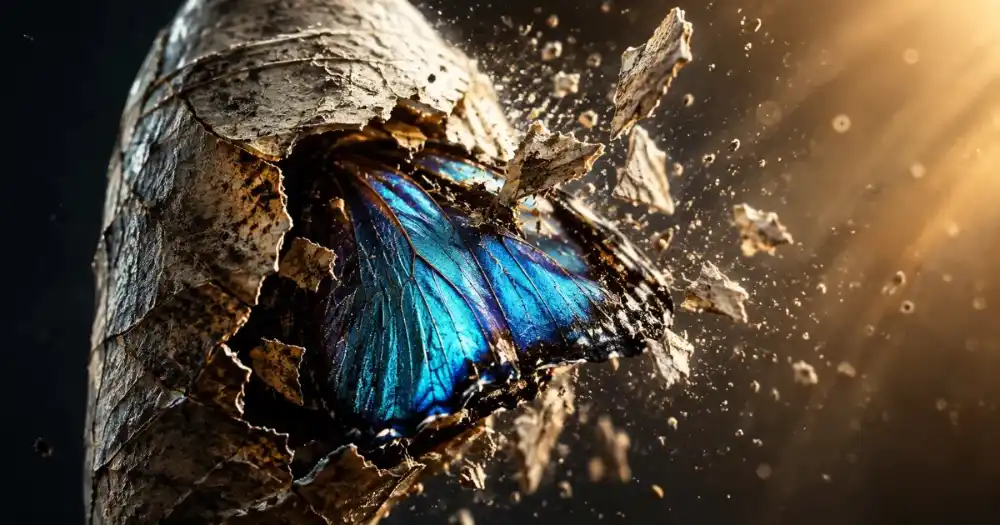
The difference represented by the passage from one stage to another through the tearing of this ceremonial garment is depression. A shock is triggered in the person who becomes aware of a new reality emerging.
This phase of disturbance only becomes problematic if it persists over time, the person being unable to bear the weight of excessive self-questioning. This then results in an absence of Joy, causing the appearance of Sadness and the development of Fear… thus making all movement (or even expression) impossible!
Far from the “classic” negative and pathological vision of our societies, depression is nevertheless a positive life event, which should be lived fully to manage it serenely and flourish in accordance with personal evolution. In an era where it is necessary to be socially recognized, performant, happy, and under the gaze of an increasingly individualistic society, the danger is to let Fear (of letting go) interfere with the perpetual movement of dynamic balance, an immutable law inherent in the 5 elements of Taoist theory.
The teachings of TCM offer natural and adapted solutions to best support these delicate phases of change that punctuate our days, our years, our life, with respect for the Body and the Spirit (Cf. Shen Zen, “Treatments” section).