Every month, the same scenario. Cramps arrive, sometimes the day before, sometimes in the first few hours. You take a painkiller, you wait for it to pass, and you just deal with it. Conventional medicine may have told you it's “normal,” or offered you the pill to regulate things. But what if your pain wasn't inevitable, but a message? In Chinese medicine, painful periods tell us something precise about your internal balance. And this reading changes everything.
What your pain says about your energy
In Traditional Chinese Medicine, a fundamental principle summarizes many things:
"If it flows, it doesn't hurt. If it hurts, it's not flowing."
Painful periods are therefore, almost always, a sign of a disturbance in the circulation — of Qi (the vital energy that animates the entire body) and Xue (Blood in the energetic sense, much broader than its biological definition). But this stagnation can have very different origins, and that is precisely where TCM becomes interesting: it does not treat "painful periods" as a single entity. It seeks your imbalance, your constitution.
Here are the two most frequent patterns I encounter in my practice:
Stagnation of Liver Qi (the energetic Liver is under pressure and blocks free circulation)
This is by far the most common profile today. The Liver, in TCM, is the organ responsible for the free circulation of Qi throughout the body. When it is constrained — and it often is, in our stressed, overloaded lives, with little respect for natural rhythms — it blocks. Result: pain that precedes menstruation, often accompanied by irritability, tender breasts, a sensation of chest oppression. Cramps generally improve... when menstruation really starts to flow. Do you recognize yourself?
Xue Stagnation with pathogenic Cold penetration (the energetic Blood stagnates, frozen by cold that has penetrated and contracted the uterine sphere)
Here, the pain is more intense, often fixed, with dark clots in the menstrual blood. This is a sign of stagnating Xue, sometimes aggravated by pathogenic Cold lodged in the uterus over time — repeated exposure to cold, iced drinks, or an insufficiency of Yang (the body's internal warmth). These women often have cold extremities, their pain is relieved by warmth, and they feel profoundly exhausted throughout the duration of their period.
These two patterns are very different — and they are not treated in the same way. This is the richness of TCM: there is no single protocol, but an approach built around who you are and what your body expresses.
What you can do right now
Even before stepping into a practitioner's office, some simple things can make a real difference depending on your pattern.
If you identify with Liver Qi stagnation, the days leading up to your period deserve special attention: reduce late and heavy meals, limit alcohol, and — as much as possible — create space for decompression. This is not a luxury, it is self-care. The Liver, in TCM, needs fluidity and space to fulfill its function of regulating Qi. When it is deprived of this, it repays you tenfold each month.
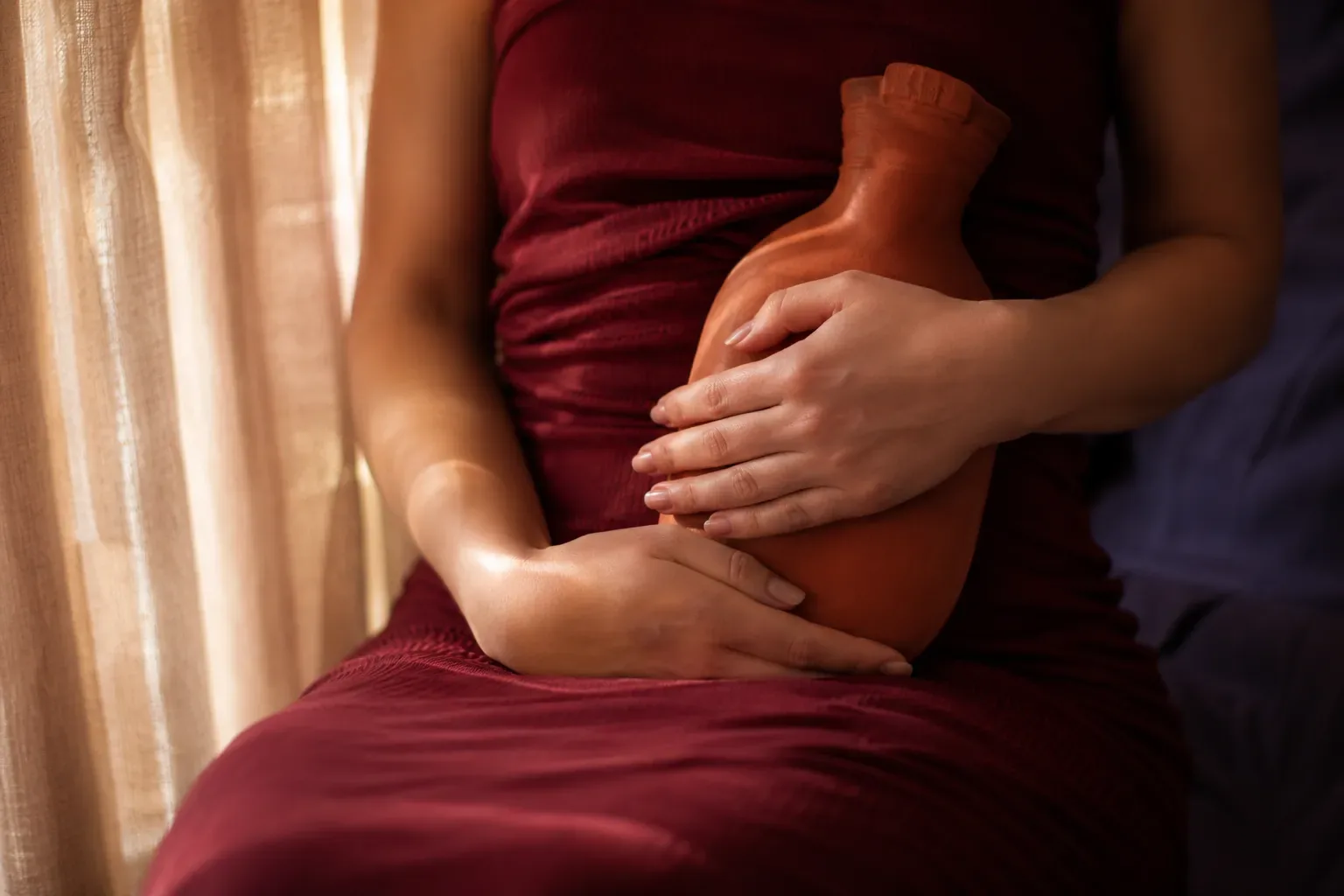
If you identify with Xue stagnation with Cold, start by avoiding raw and cold foods in the week before your period. Favor warm and cooked dishes, fresh ginger in infusions, cinnamon. And place a hot water bottle on your lower abdomen as soon as the pain appears — this is not an old wives' tale, it's exactly what TCM prescribes: warm the Yang to restart the circulation of Xue.
Moxibustion — a technique consisting of warming acupuncture points with an incandescent moxa stick — can also be practiced at home very simply. Two points on the Conception Vessel located on the lower abdomen, Qi Hai — CV 6 and Guan Yuan — CV 4 (respectively 1.5 and 3 fingers below the navel), are particularly indicated a few days before menstruation for patterns with Cold. Ask your practitioner to show you how to do it during a session — it's simple and remarkably effective for gentle self-medication.
What if we really treated the cause?
What strikes me most, after years of practice, is the resignation with which women arrive at the clinic. Many have learned to "deal with it," not to complain, to normalize pain that can nevertheless be disabling. They have been told it was hormonal, that it was inevitable.
Chinese medicine does not consider suffering every month to be inevitable. In acupuncture, by working on the meridians of the Liver, Spleen, Kidney and the Conception Vessel (the central meridian governing the uterine and genital sphere), we remove the stagnations of Qi and Xue, and gradually regulate the cycle. Results take time — allow 2 to 3 cycles to observe a real transformation — but they are lasting, because we address the root of the imbalance, not just the symptom.
In practice, the most strategic time to come for a session is the week before your period, when the stagnation begins to be felt. Intervening at this time means acting proactively — before the pain fully sets in.
We say it's better to maintain your health when everything is going well than to have to fix it when everything is going wrong. Your periods are a valuable window of information into your overall balance. Listening to them is already starting to take care of yourself.