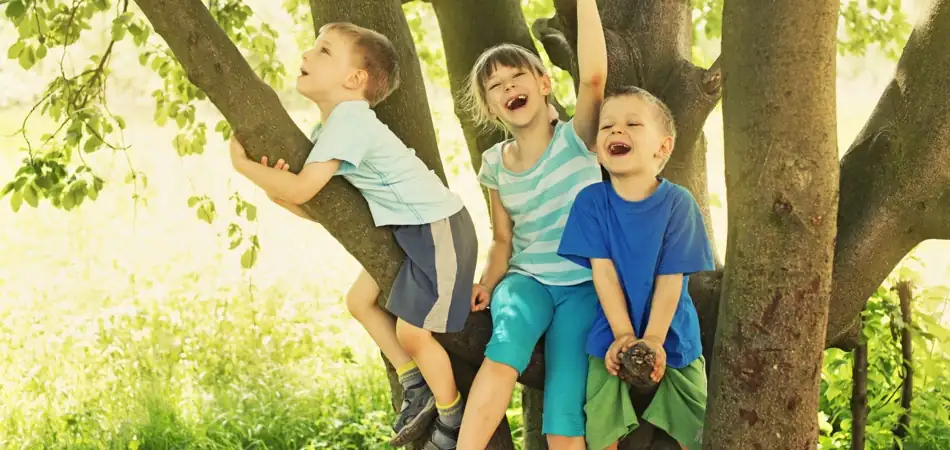
How can we define this emotion, both simple and so rich? While easily observable in early childhood, it generally becomes more subtle in an adult's life. We readily think of a child for whom everything is an excuse to laugh, play, love, fully enjoy the present moment and freely of any thought. Or of that teenager with remarkable stamina, who goes out 4 nights a week to party with friends until the early morning without particular concern… after all, don't we speak of “the carefree nature of youth”?
Joy also takes various forms. It can be a passing reaction, a state of mind, a life goal, or even an obsession. It is its absence that is feared and perceived as a disturbance or a personal and social failure. Indeed, isn't the purpose of our existence, after all, the pursuit of the ultimate Grail? “Being happy,” “flourishing,” “self-actualizing,”… Whatever its personal interpretation, isn't that the reason that motivates an individual to get up every morning?
State of Joy or sensation of pleasure?
But this cult of happiness, once maintained, can turn into a vicious circle. If we now consider that one “must” be happy, then the active search for this state can give the illusion that this goal will necessarily be achieved by implementing what are deemed necessary means and conditions; the illusion of control takes over. Every reflection and clever calculation to procure “the best,” every judgment to place oneself on this artificial scale of values is in fact a step backward in this frantic race. Instead of flourishing, the being finds itself subjected to this dictatorship to the point of constantly “living in their head.” This phenomenon can be easily observed today in our Western societies.
TCM Perspective
In Traditional Chinese Medicine (TCM), Joy is the emotion of the Fire element, whose season is summer, the organ is the Heart, the climate is heat, and the sense is touch (the opening is the tongue).
As mentioned above, a disturbance in this emotion will typically be observed in case of deficiency. This deficiency will be the direct consequence of worries. A mind troubled by concerns and thoughts of all kinds is indeed unable to enjoy the present moment and what it has to offer. Thus, a child who spends the day playing with a cat is indeed rarely subject to deep reflections. This vital exercise of taking care of one's inner child is the subject of all meditation and other exercises aimed at achieving mindfulness. These will be an excellent complement to the practitioner's work in restoring balance.
An excess of Joy will, however, be just as possible and problematic. In Chinese medicine, it is said that the Heart is the home of the Shen (the Spirit = cognitive faculties), and that blood is its vehicle. In excess, uncontrolled or totally unrestrained Joy will have the effect of causing the Spirit to leave its home, leading to excitement, hysteria, madness, or dementia. In this case, the practitioner will take care to calm this excessive energy (the “Heart fire”).
A person affected by disorders of the Heart and/or Spirit may thus be subject to profound emotional distress. Regarding Joy, if deficiency is more frequent than excess, the consequences of such a case should not be overlooked. No energy – however “positive” it may seem – can be good in long-term excess. In accordance with TCM philosophy, balance is the keyword for a healthy and fulfilling life. Joy is the best example of this.