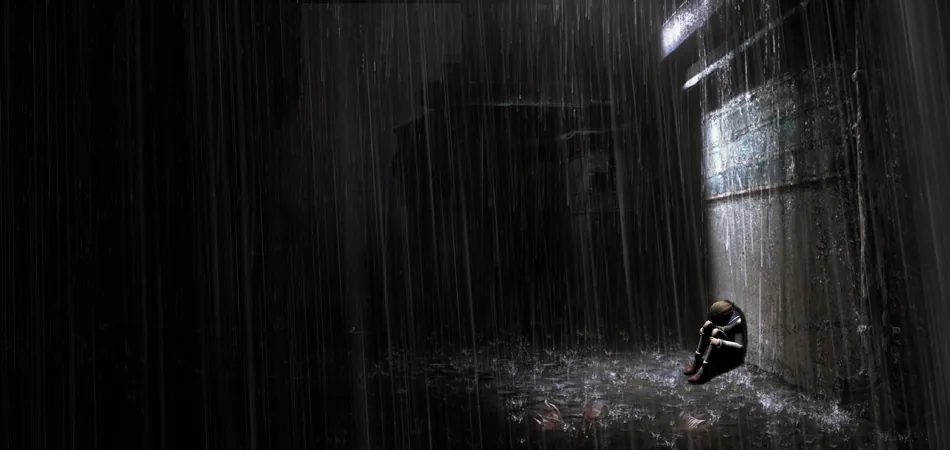
Like the stages of a cycle that punctuates our days, our years, and ultimately our lives, the emotions we feel throughout our experiences mark and define our path. While some of these experiences are undeniably positive due to the pleasant emotion—Joy—that accompanies them (the bliss of a first love, the pride of passing an exam, the euphoria of a sports victory, etc.), others, on the contrary, can represent a bad memory, or even a painful event we wish to forget.
The simple reminder of a failure, a separation, a dispute, a loss... can affect us to the point of changing our mood. This particular emotion that causes regrets, melancholy, tears, loneliness, pessimism, and dark thoughts, is Sadness.
But beneath this negative aspect that we generally fear, this emotion remains essential. It defines our sensitivity, and our ability to appreciate the value of what we acquire and lose: a friendship, for example. Like Yin to Yang, darkness to light, there is no Joy without Sadness! It also teaches us an important social value: empathy. When we observe an external situation that we have already experienced, we understand the pain it can cause and suffer with the person enduring it... thereby paving the way for other, no less important human values: compassion, mutual aid, solidarity, tolerance, etc.
Sadness, however, becomes pathological in a person who lives through it, failing to overcome it, or who remains unaware of it out of fear of suffering. It has then taken over, and emotional harmony is broken. It is the absence of Joy, emotional blockage, depression, the loss of a zest for life… From its status as a natural and healthy reaction, Sadness then becomes a self-destructive way of life.
The TCM Perspective
In Traditional Chinese Medicine (TCM), Sadness is the emotion of the Metal element, whose season is Autumn, whose organs are the Lungs, whose climate is dryness, whose movement is decline, and whose opening is the nose.
Intense Sadness will have a twofold effect:
- it will directly affect our breathing, which will become short, choppy (crying), irregular…
- it will have a dramatic impact on the energy of the lungs, whose primary function is to capture energy from the air and circulate it throughout the body.
As the intake of external energy is disrupted, the body draws on the reserves of innate kidney energy (Yuan Qi), which is the purest and whose main characteristic is its limited quantity (when it is depleted, death occurs). Chronic fatigue then sets in, a typical sign of conditions like depression, for example.
Furthermore, it is said that the upper and lower parts of the body are connected by a link between the lungs and the kidneys in a Yin-Yang relationship. If this balance is broken, respiratory problems appear, and we will observe: shortness of breath, asthma, emphysema, cough, dyspnea, a weak voice, etc.
Finally, in TCM, it is said that the lungs are the master organs of the skin (the protective tissue against external attacks). An impairment of their energy will invariably lead to a symptom related to this layer, depending on its intensity: irritations, dry skin, eczema, psoriasis, shingles, etc.
Treating a syndrome linked to deep-seated Sadness will therefore, in TCM, involve working on the energy of the lungs, but also that of the kidneys. Indeed, as we mentioned earlier, the energies of these organs are intimately linked, which is reflected on the emotional level: all Sadness is linked to a Fear, forming a powerful, self-perpetuating vicious cycle. In the long term, becoming aware of the origin of these emotions will be a delicate but necessary subsequent step.