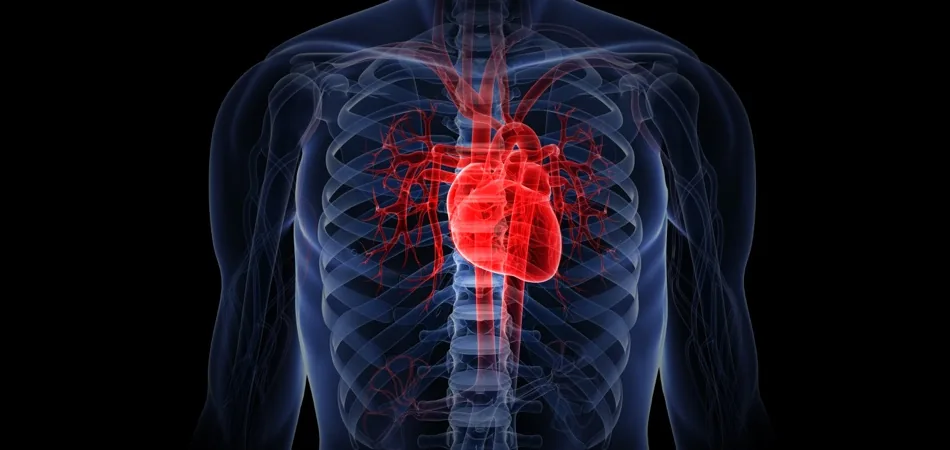
Located in the rib cage—two-thirds of it on the left side—the Heart is the main component of the circulatory system (along with the veins and arteries). This hollow, muscular organ measures 15 cm on average, weighing about 350g.
A true "organic engine," it has a primary function: to ensure blood circulates through the arterial and venous network to supply the brain, organs, muscles, and all the cells of the body. Since blood carries oxygen and nutrients (among other things) essential for their proper functioning, this role is vital for survival!
The Heart is composed of 2 distinct parts:
- The right heart receives deoxygenated blood after it has circulated through the body, and then sends it to the lungs, where it will be re-oxygenated.
- The left heart receives this re-oxygenated blood to propel it throughout the body via the aorta (the largest artery) and the arteries.
Each of these hearts is composed of an atrium which receives blood, and a ventricle, whose contraction pumps the blood out. These movements of relaxation and contraction of the ventricles allow for continuous and regular pumping. They are caused by the transmission of an electrical signal unique to the heart, the frequency of which dictates the heart rate. This rate varies according to age (faster in children), sex (faster in women), emotions, hormones, physical effort, etc. — in short, the body's needs.
The TCM Perspective
The Heart is the organ of the Fire element. The associated climate is Heat, the season is Summer, the sense is touch (its opening is the tongue, the “sprout of the Heart”), the emotion is Joy, and its paired organ is the Small Intestine. The Heart governs the Blood Vessels.
It not only allows blood to circulate throughout the body but also facilitates its purification by transporting toxins and eliminating carbon dioxide. The body, thus irrigated and nourished, receives everything it needs to function—in other words, Life. And by extension, the feelings that make us feel alive: Joy and Love.
This is why Taoists consider the Heart to be the "Emperor of the organs and the psyche." Linked to emotionality, it is this organ that regulates the body through its action on the brain and the five senses. It allows us to manage external elements and adapt internally in response.
It is also described as the "abode of the Spirit," housing the Shen—a term representing the entirety of our cognitive abilities, our intelligence, and our Consciousness, all of which are conveyed by the blood. A Heart with good energy will thus ensure good mental health and clarity of Spirit. Otherwise, symptoms related to "Heart Heat" may appear: disturbances of the Spirit, insomnia, anxiety, palpitations, etc.
One rarely acts directly on such a precious element of our Being, for fear of disturbing it! This is why to treat a pathology related to the Heart, the practitioner will often use the Pericardium meridian, also known as its "prime minister," which is responsible for protecting and watching over this structure.
Poor management of emotional states, or conversely, excessive repression of them, can harm the Heart's energy. This is also true for a person who takes life too seriously, at the expense of the freedom needed in daily life.
Deficient or blocked Heart energy can thus be characterized by:
- Cardiac disorders (tachycardia, palpitations, chest pain, arrhythmia, extrasystole, coronary artery disease, etc.)
- Spirit disorders (delirium, insomnia, poor concentration, anxiety, etc.)
- Emotional disorders (hypersensitivity, sadness, mood swings, hysteria, difficulty experiencing Joy, Love, etc.)
- Circulatory disorders (phlebitis, varicose veins, Raynaud's syndrome, etc.)
- Sensory disorders (especially taste) and tongue issues (canker sores, glossitis, etc.)
- Sweating disorders