Note: Although many techniques are rooted in Buddhism or Taoism, it is not necessary to adhere to either to achieve spiritual development through Qi Qong.
Many consider this art to be "the Rolls-Royce of martial arts," due to its effectiveness and subtlety. This Chinese jewel, whose techniques were long kept secret, offers everyone a tremendous means of maintenance and self-treatment.
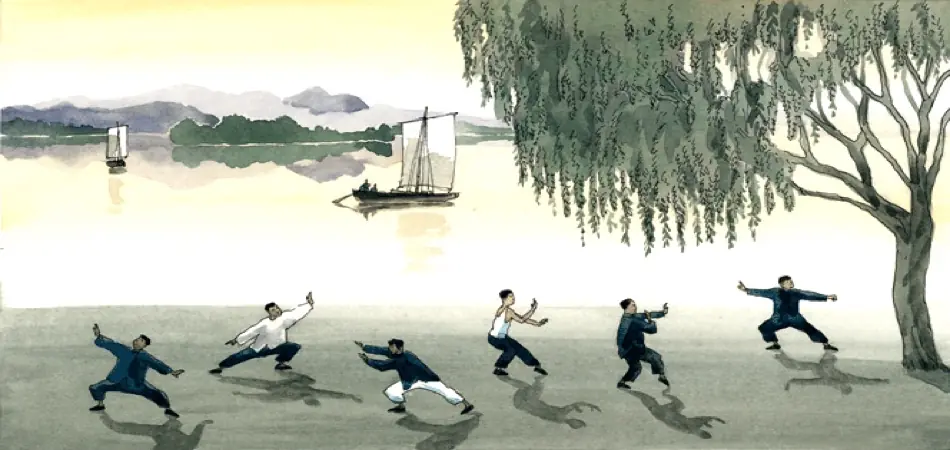
The term "Qi Qong" (or "Qi Gong," depending on the translation), coined in China in 1950, can be translated as "work on Qi" or "method of working with Qi." It refers to all the exercises aimed at maintaining, or even improving, one's own level of Qi, while promoting its smooth circulation throughout the body. It generally consists of a sequence of slow, precise movements, performed with special attention to breathing and one's level of awareness. The main advantage lies in the discipline's accessibility, as it can be practiced anywhere, regardless of age or physical condition, alone or in a group.
Although the practice of this discipline only truly took off in the 1980s, it is in fact much older. Its techniques had been kept in the shadows by grand masters, but the appeal of its mystical side eventually created such a craze that 20% of the Chinese population began practicing the exercises daily during that time.
Therapeutic Effects
When taught, Qi Qong allows the practitioner to transmit techniques to someone wishing to maintain their daily health.
When used as part of a treatment, it allows the practitioner to directly manipulate the energy flows of the person being treated, either through vibrational movements or a simple laying on of hands.
With this art, one works directly on energy, on the ethereal. The level of immateriality gives this practice such a subtle dimension that an individual may see their general condition improve without understanding the effects, which are difficult to express; some describe, for example, a numbness, a sensation of an energy tide, or even a feeling of "better connection to the universe"... The benefits of Qi Qong can also be general or localized (by organ, by "function" such as digestion or sexuality, etc.) depending on the exercises practiced or the area the practitioner is working on.
In any case, we return to one of the basic principles of TCM: any pain or pathological condition—physical or psychological—is caused by poor circulation of vital substances (Qi and bodily fluids). Improving the flow in this aspect of the body therefore naturally helps to resolve the disorder! And that is precisely the goal of Qi Qong: to clear the pathways of the body's main meridians to strengthen and transform one's energy.