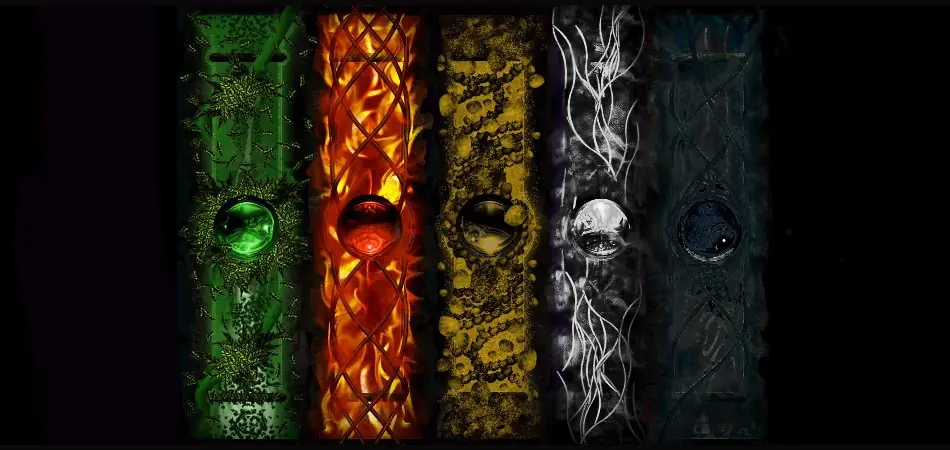
This theory is – along with the Yin/Yang theory – one of the fundamental theories of Traditional Chinese Medicine (TCM). In this view, natural substances are used to categorize all things in Nature and humans, and to explain their relationships to each other: seasons, colors, emotions, organs, senses, flavors…
Origin
Tsou Yen is said to have been the founding father of the theory of the 5 elements (literally translated from Chinese as "5 movements,", or "5 phases"). The 5 elements are: Wood, Fire, Earth, Metal, Water
Each of these elements, "breaths," or "energies," is to be related to an organ of the human body, as well as a season through which it manifests itself in a Yin/Yang balance. By knowing and understanding these elements – or phases – we can then discover how to balance the extremes of each season and grasp the opportunities for evolution brought by them. Our organs are intimately connected to seasons, temperatures, colors, tastes, … to name just a few associations, each of them having a significant impact on our health and well-being.
- Wood: The season of the Wood element is Spring, a period characterized in Nature by activity and renewal (animals emerge from hibernation, plants bud, water thaws and flows again, etc.).
- Fire: It is followed by Summer, the season of the Fire element, a period of abundance during which ideas and projects developed during Spring flourish and bear fruit.
- Earth: The Earth phase arrives towards the end of Summer ("Intersaison" or "Indian Summer") and represents harvest time, during which we can fully enjoy the maturity of the work accomplished and the seeds sown earlier in the year.
- Metal: Metal is in phase with Autumn, a season of decline marked by the gradual retreat of Nature preparing for the arrival of Winter.
- Water: Finally, the forces of Nature rest during the Winter months of the Water element, like a dormant seed, awaiting the return of Spring to hatch and begin a new cycle.
Interpretations
The 5 elements are often represented in a cyclical diagram highlighting the connections between organs, as well as the consequences of an imbalance in one element on the other elements of the cycle.
There are two important cycles in the theory of the 5 elements, each having a distinct interpretation:
Production Cycle – each element gives birth to another. Water allows wood to grow, wood allows fire to burn, earth produces metal, a conductive element for water, which in turn nourishes wood… and so on.
Control Cycle – each element dominates, or destroys another. Water extinguishes fire, fire melts metal, metal cuts wood, which depletes the earth, and the latter dries out water by absorbing it.
The theory of the 5 elements and the Yin/Yang theory are interdependent. Indeed, the ultimate goal in TCM being to achieve global Yin/Yang balance, the state of the 5 elements in a person will indicate the treatment methods for the observed imbalances.